
Unifying Customer Success Into Partner Experience Cloud
Overview
Partner Experience Cloud brought Customer Success into one unified platform, giving Cisco partners a unified place to review account health, product adoption insights, and renewal risk for each customer instead of switching between two disconnected tools. The result: engagement increased 20%, task completion reached 85%, and 800+ partners have onboarded since launch.
Contribution
Research, Interaction Design, Prototypes
Duration
10 months
800+
partners onboarded
20%
engagement increase
85%
task completion


 Critical


Context
Customer data was fragmented across two platforms
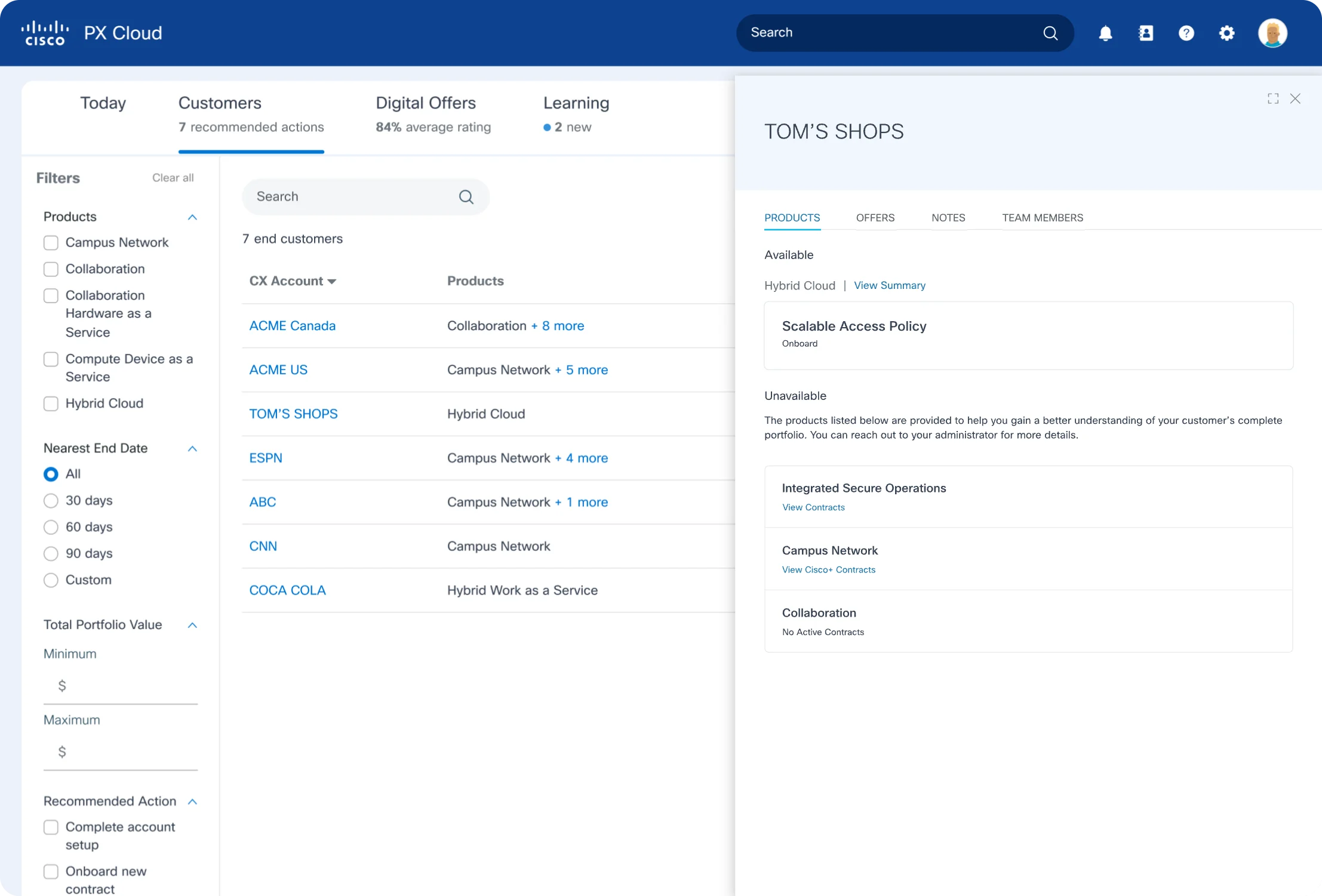
PX Cloud: Sales-centricWho the partner sells to — accounts, contracts, portfolio value
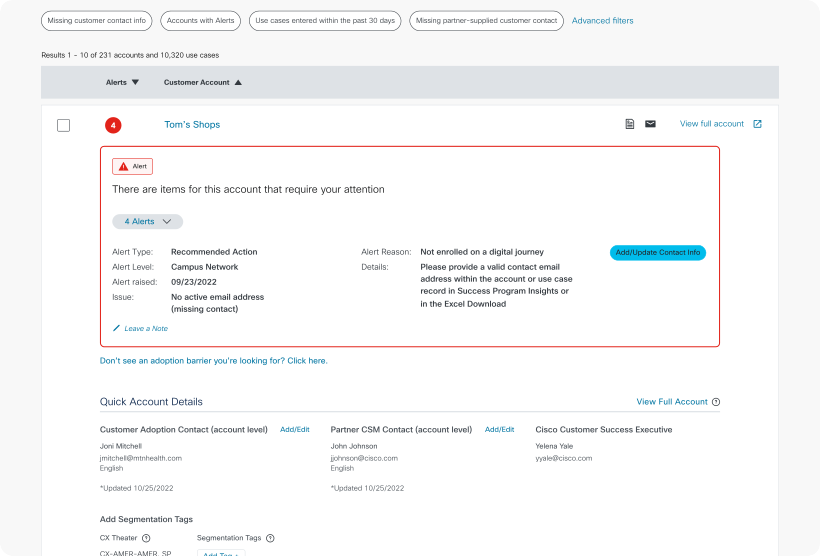
Lifecycle Advantage: Engagement-centricWhere Cisco flags the account — alerts, use cases, outreach contacts
One platform, unified customer data.
Partner users can now review account health, adoption signals, and renewal risk of customer account without switching tools or reconciling conflicting data.
We spend hours each week just trying to reconcile customer data between the two platforms.
Goal
One place where partners could see account health, adoption signals, and renewal risk for the same customer.
Key Decisions
01
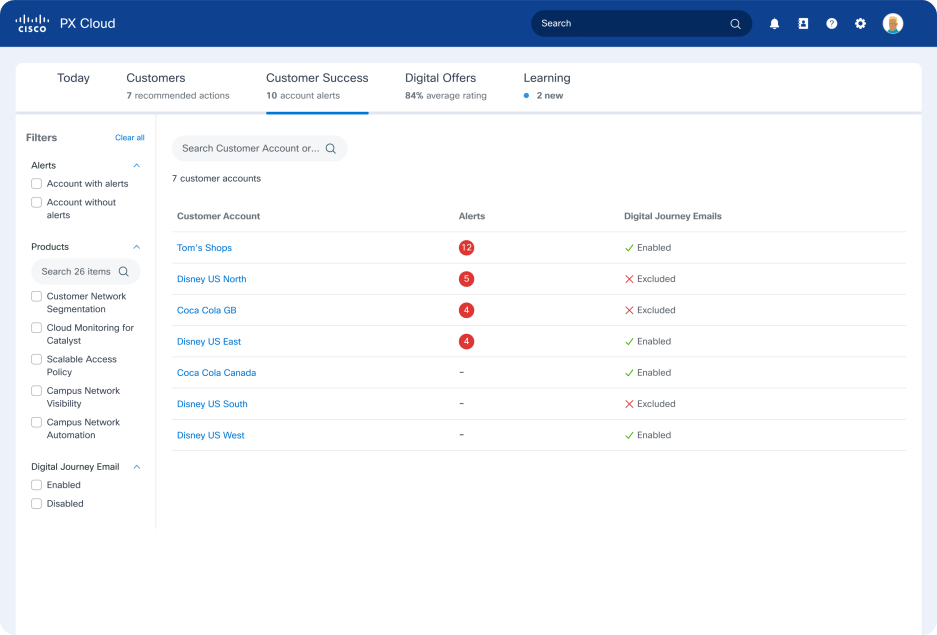
Customer Success combined into PX Cloud
Before
Deciding on how we combine Customer Success into existing navigation

Partners relied on two separate platforms to track customer adoption and health, and when the two disagreed, partners cross-checked records by hand, sometimes losing enough confidence in the data to stop tracking a customer altogether. Combining the platforms at the data layer meant a backend refactor that was out of scope, so I validated whether the right label alone could fix the confusion. A 15-partner card sort confirmed it could: the mismatch shown below disappeared once renamed inside PX Cloud, avoiding what would have been a costly re-training effort across the entire partner base.
Separate Lifecycle Advantage area
Ruled out the separate Lifecycle Advantage area. Partners assumed it covered all Lifecycle Advantage features.

Customer Success inside PX Cloud
Shipped Customer Success as a tab inside PX Cloud. Partners understood immediately that it lived inside their existing account, not a separate product.

02
Structure over flatness
Integration needed a structure that helped partners identify customers needing attention.
The Lifecycle Advantage presents accounts, alerts, and product adoption insights as long vertical lists. Partners typically reviewed accounts during live customer calls, with the account owner on the line, exactly when the most important adoption signals were easiest to miss.
Before
Flat information architecture
Dense information organization led to poor discoverability. The original workflow started with a critical alert, then required partners to scroll down the same dense page to find the product adoption context needed to act on it.
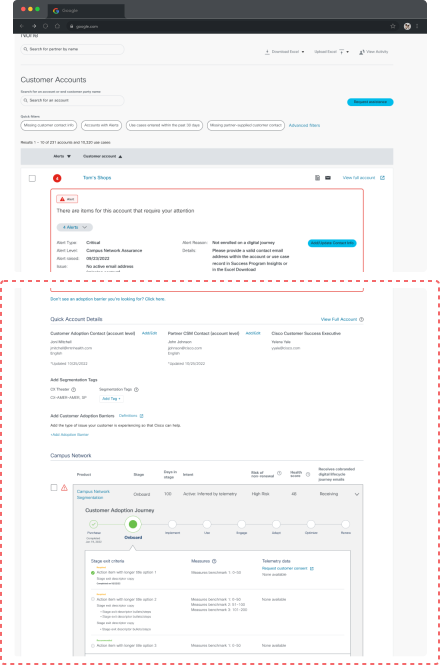
40% of partners never scrolled past this point.
New design
New workflow: which customers are at risk, why, and what to do about it.
I restructured the workflow into a three-level hierarchy: prioritization, account context, then product adoption detail. Filtering or priority sorting within the existing flat structure was rejected, partners needed to locate a specific alert in seconds, not filter their way to it. Alert cards went through the same test: a compact version hid the alert type, so I chose a larger card that showed severity at a glance, worth the extra space for partners scanning during a live call. Time to find the alert that needed action dropped from 47 seconds to 16.
03
Organizing product adoption information that drives better decisions
New design
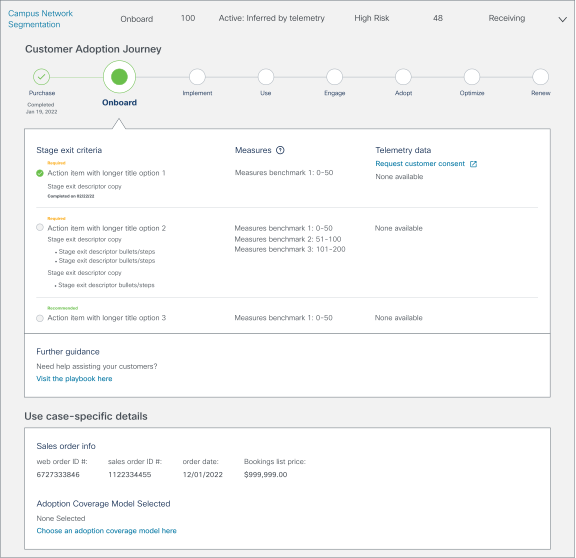
Information order determined whether partners could act.
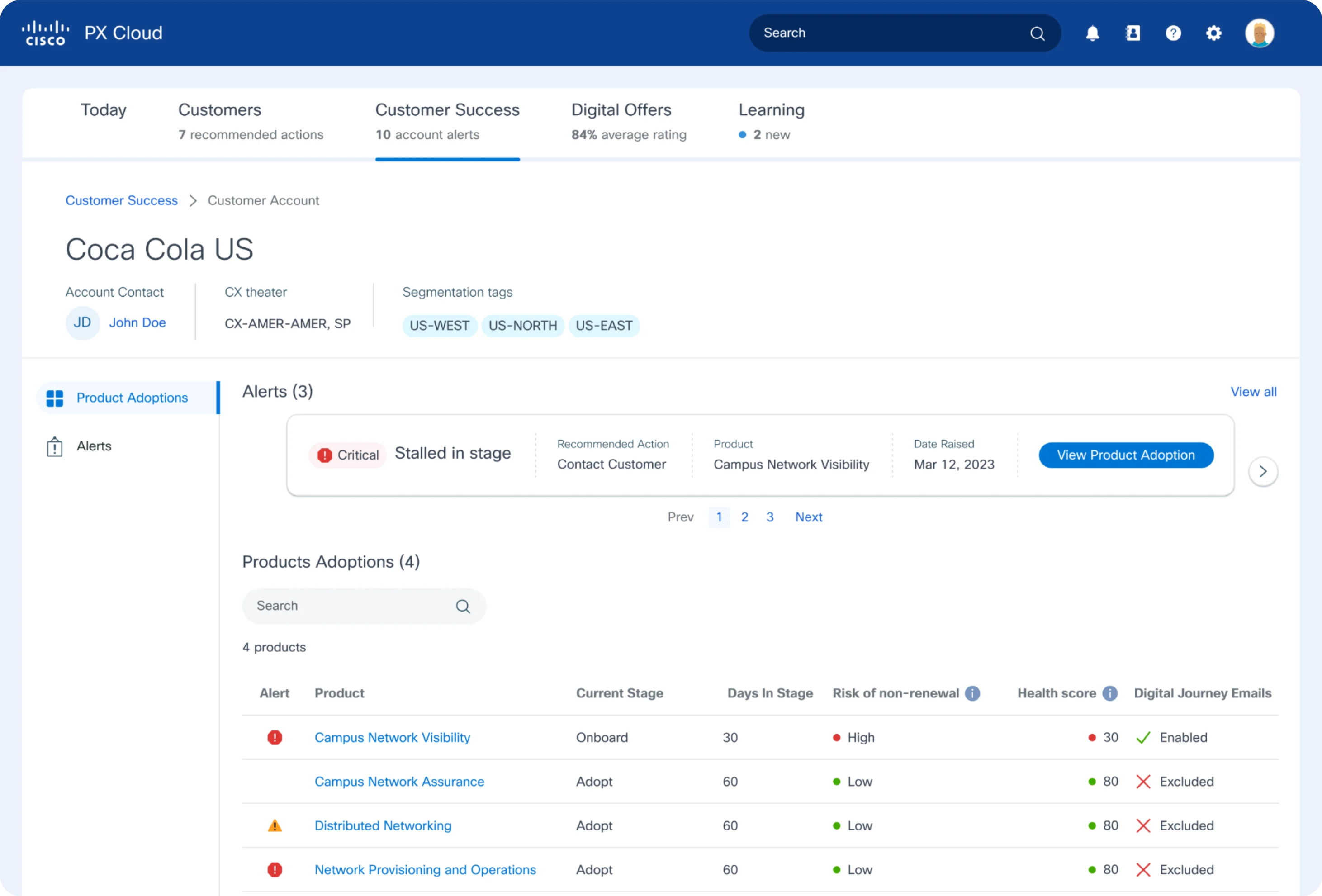
The page follows how partners decide. The alert comes first, with its severity and recommended action. Below it, the lifecycle journey shows where the customer is stuck, and stage tasks list what to do next. Health score and days in stage stay visible on the side, so partners never lose context while they act.
Impact
The unified Customer Success platform launched in Q4 2023.
800+ partners migrated from Lifecycle Advantage into PX Cloud within three months of launch. Unified navigation gave partners a single context to explore: engagement increased 20% as partners began actively exploring customer data rather than only logging in for compliance reviews. The three-level hierarchy lifted task completion to 85%, ending the need to cross-reference between tools during live customer calls. The alert-first layout on the Product Adoption detail page enabled 8 of 10 partners to complete the full workflow from identifying an alert to acting on the associated tasks.
Migrated from Lifecycle Advantage into PX Cloud.
Partners actively explored customer data instead of only logging in.
Customer reviews could be completed without switching tools.